


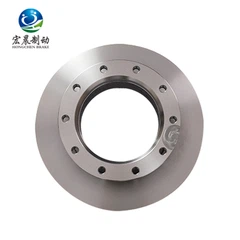


1, termeni legați structurali
(1) Suprafața discului de frână
This is the part where the brake disc comes into direct contact with the brake pads, used to generate friction to brake the vehicle. The disc surface is usually flat, but some high-performance brake discs may have special textures or slotted designs. For example, the surface of a slotted brake disc has shallow grooves that help to remove debris and heat generated during braking, maintaining stable braking Performanță .
(2) Inel de frână
It is the main working part of the brake disc, usually a circular structure. It rotates around the wheel hub, and during braking, the brake pads clamp the brake ring, causing the wheel to stop rotating through friction. Its thickness is an important parameter because the brake ring will wear out after long-term use. When the thickness is below a certain limit, the brake disc needs to be înlocuit .
(3) Hub - Secțiune de montare
O structură folosită pentru asigurarea discurilor de frână pe roțile vehiculului . se asigură că discul de frână se poate roti sincron cu roțile și necesită o poziționare precisă în timpul instalării pentru a asigura un spațiu chiar între disc
(4) conducte de ventilație
Exists in ventilated brake discs. These channels are usually distributed radially or in other shapes inside the brake disc, and their function is to allow air to circulate inside the brake disc. During the braking process, the brake disc generates a large amount of heat. Ventilation channels can help dissipate heat and prevent the brake disc from experiencing thermal degradation due to supraîncălzire, menținând astfel o performanță bună de frânare .
2, termeni legați de performanță
(1) decolorează
The phenomenon where the braking performance of the brake disc decreases due to excessive temperature during continuous or high-intensity braking. For example, when driving downhill for a long time, frequent use of the brake will cause the temperature of the brake disc to rise sharply. When the temperature reaches a certain level, the friction coefficient between the brake disc and brake pad will decrease, making the brake pedal feel mai moale și distanța de frânare mai lungă .
(2) Coeficientul de frecare
Este un parametru care măsoară amploarea de frecare între discurile de frână și plăcuțele de frână . este o valoare fără dimensiuni, iar amploarea sa afectează în mod direct performanța de frânare . Combinația de discuri de frână și plăcuțe de frână făcute de diferite materiale va avea coeficienți de frecare diferiți {{2}, de exemplu, coeficienți de fricțiune, de exemplu, de fricțiune a combinațiilor Discurile de frână sunt relativ stabile, ceea ce poate oferi un efect de frânare mai bun .
(3) Cuplul de frânare
It is a physical quantity that measures how much braking torque a brake disc can generate during braking. It is related to factors such as the quality, speed, friction between tires and the ground, and friction between brake discs and brake pads of the vehicle. The greater the braking torque, the faster the vehicle can stop. In automotive design, engineers determine the appropriate braking cuplu în funcție de tipul și scopul vehiculului .


